
Federal BOP Release Outcomes
A BOP record may show “Released” with a date or indicate that a person is not in BOP custody. Neither phrase should be stretched beyond its scope. Release from imprisonment can lead to court-administered federal supervised release. “Not in BOP custody” can also reflect USMS pretrial detention, state or local custody, immigration custody, an incomplete historical record, or another non-BOP status.
No BOP institution was identified inside Dent County. A local arrest on a federal matter may begin in a county or contract jail under U.S. Marshals authority. Only after sentencing and designation does BOP become the principal prison locator. This sequence explains why a federal detainee can be absent from the BOP search while still confined.
| Federal phase | Primary source | What to confirm |
|---|---|---|
| Pretrial detention | Federal docket, clerk, USMS district | Detention order and current custodian |
| Sentenced imprisonment | BOP Inmate Locator | Facility, status, and release information |
| Release from BOP | BOP result and federal docket | Release date and any supervision term |
| Other custody after BOP | Named receiving agency | Whether confinement continues elsewhere |
Confirm a Federal BOP Release
The BOP Inmate Locator accepts a federal register number or a name with biographical filters. A register number is the stronger key. Names can collide, change, or be entered differently across systems, so compare age and other available details before attributing a release date.
- Search by register number when known. Otherwise enter exact name and available age, race, and sex filters.
- Open the matching result and transcribe the status and release date exactly.
- Check the federal criminal docket for the sentence, detention order, release order, and supervised-release term.
- If the result says not in BOP custody, identify whether USMS, a state, a locality, or ICE has custody.
- Confirm a transfer or current placement with the named responsible agency.
The official federal search screen is shown below.
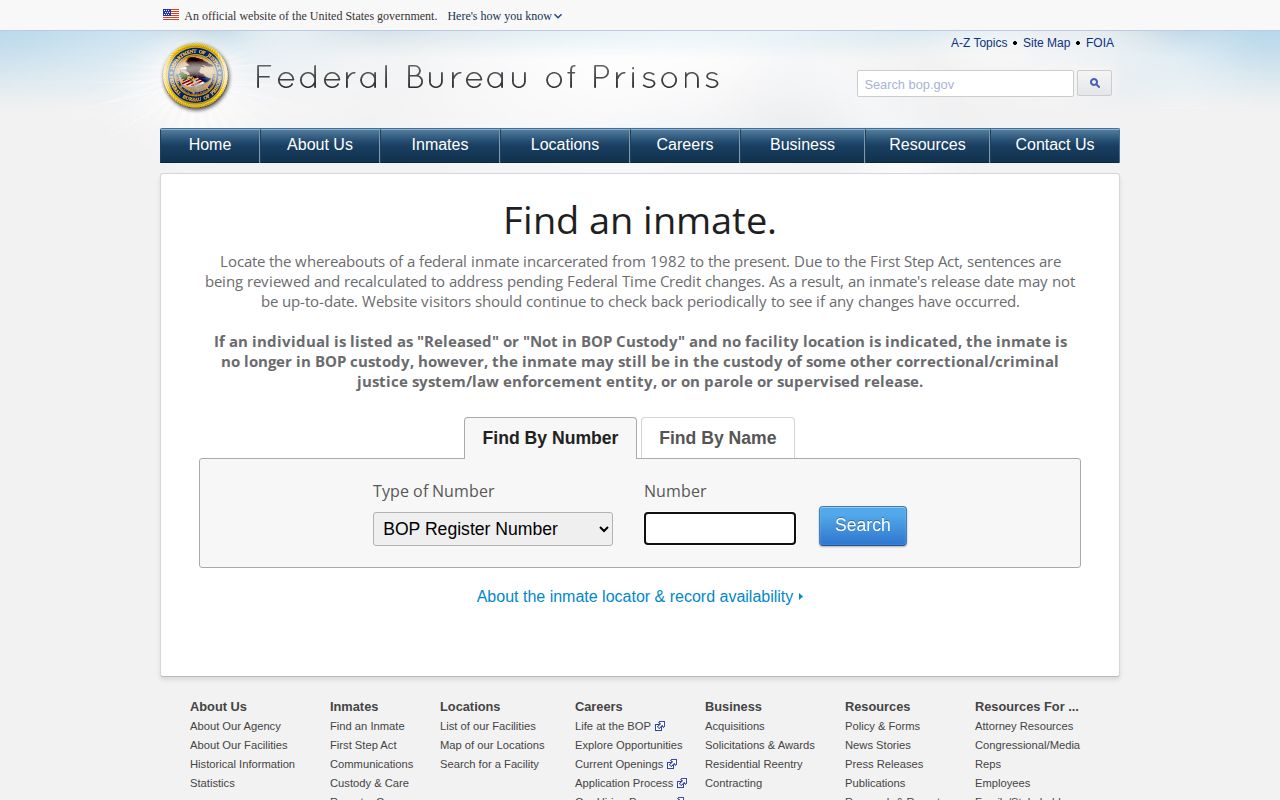
Its federal scope must not be confused with the Dent County Jail or Missouri DOC systems.
Federal BOP Record Contact
The Bureau of Prisons is a nationwide system, not one Dent County building. Contact details depend on the designated institution or office shown in the federal record. The research did not identify a Dent County BOP institution and supplies no local federal prison address or phone.
Locator: official BOP Inmate Locator
Sentenced federal custody and release records
Local Dent County institution: none identified
For a docket document, use PACER or contact the federal clerk. PACER may require an account and may charge fees. During the pretrial period, the relevant U.S. Marshals district and court are more useful than BOP because USMS manages detention and transport.
BOP Status Language
A federal locator result is an administrative record with a limited purpose. “Released” documents a BOP custody outcome and date in the locator. It does not state that all court supervision ended. Federal supervised release is imposed by the sentencing court and administered through U.S. Probation after imprisonment.
Historical federal locator data can also be incomplete. Preserve the exact result, access date, register number, and source language. A county booking record, Missouri DOC record, or ICE locator may document a separate episode before or after the BOP event.
- Register number
- The federal identifier used for the cleanest BOP match.
- Released
- The locator’s record that BOP custody ended on a stated date.
- Supervised release
- Court-imposed federal supervision after imprisonment, not BOP confinement.
- Not in BOP custody
- A narrow BOP status that does not prove present freedom.
BOP Versus Marshals Custody
The U.S. Marshals Service manages federal pretrial detainees, transports prisoners, and uses contracted detention space. It has no public nationwide detainee locator comparable to BOP. A person moved out of Dent County under federal authority may remain absent from BOP until sentencing and prison designation.
Use the federal docket to identify the court, detention order, writ, release order, and case status. Ask the clerk or relevant USMS district about the proper public contact route. Do not call transport from Dent County Jail to a federal contract jail a release. It is a change in custodian.
Federal Release Record Chain
A complete confirmation can require three records. The county jail transaction shows when Dent County relinquished custody. The federal docket shows the legal detention or release order. The BOP locator shows the sentenced-prison status and federal release date. Each record should be tied to the same person through identifiers and case numbers.
If another agency accepted the person after BOP, find that receiving record. A state detainer can lead to state custody. An immigration matter can lead to ICE. A later local case can produce a county booking. The BOP date remains valid for the BOP episode while the person is confined elsewhere.
Requesting a record works best when narrow. Identify the register number, federal case number, institution, and date range. Ask for an existing public release field or order rather than a custom explanation. Federal exemptions and privacy rules can limit nonpublic material.
Read Federal Release Dates
A release date in the locator should be recorded with its label. Do not treat it as a sentence-completion calculation made from the judgment. Federal sentence administration can involve prior-custody credit, statutory rules, court changes, and other custody. The official record controls.
The federal docket may separately show a detention hearing, bond order, judgment, sentence, and supervised-release term. Those dates serve different purposes. A release order authorizes a change, while the responsible custodian records when it happened. Transportation and receiving-agency intake can create further timestamps.
When a projected date and a released date differ, preserve both sources and explain their labels. Avoid selecting the date that merely appears most favorable or recent. Note: the receiving-custody check is essential before describing a BOP release as a community return.
Dent Federal Custody Trail
A person first arrested in Dent County can generate local, federal, and later prison records. Start with the sheriff’s transfer destination. A federal writ, case number, or Marshals handoff points to the federal court path. If the matter remains a Missouri case, BOP is the wrong system.
Use the county record to establish the local exit, not to claim a federal release. Use the BOP record to establish the federal prison event, not to claim that local holds ended. This division prevents a common error in mixed-jurisdiction cases.
For one named person, confirm identity with more than a name. Match the federal register number, date of birth or age, case number, and custody dates. Keep a source access date because federal and local statuses can change.
After a Federal BOP Release
Federal supervised release is part of the court sentence and begins after imprisonment under the judgment’s terms. U.S. Probation administers it for the sentencing court. It differs from Missouri parole, which belongs to the state system, and from probation ordered in a Missouri case. The BOP locator does not serve as the complete supervision record.
Read the federal judgment for the length and conditions of supervised release. Later docket entries may show modification, revocation, or discharge. A released BOP status therefore answers the prison-custody question but not every post-imprisonment question.
If a Dent County address appears in release planning, that does not place the person back in county jail custody. Local residence, federal supervision, and local detention are separate facts. Use the federal court and U.S. Probation path for supervision, and use the sheriff only for a distinct Dent County booking.
A community-corrections placement can also require careful wording. BOP may use residential reentry or home-confinement arrangements as part of federal sentence administration. Those statuses are not the same as final discharge. Record the locator language, facility or placement, and date, then check the judgment and responsible federal office before describing the custody result.
If the locator carries a past release date, compare it with the federal judgment and any later docket activity. A later federal case, supervision violation, state arrest, or immigration event may create a new custody episode. The old BOP date remains historical evidence for the earlier sentence, not proof of current location. Search each documented episode on its own identifiers and dates.